


TESTing start with links
????
|
|
|
|
In
Recognition of WC Stevenson: Display > Architecture: ALL Businesses Churches Courthouses Miscellaneous Residences Schools > Photos > News Articles from 1941, 1956, 1999 > Courthouse Bee County > Lady Justice
William Charles Stephenson, Jr. was born to William Sr. and Winifred "Winnie" E. Lenahan Stephenson on September 9, 1876, in Buffalo, New York. His grandparents were Joseph E. Stephenson, Catherine O'Brien Stephenson, James Lenahan, and Margaret Brennan Lenahan. His first remarkable work was a five foot statue of St. Francis of Assisi, which he sculpted at 14 years old. He won an art scholarship as a result of the work, which eventually led to the advanced study of Architecture at the ART STUDENTS LEAGUE of Buffalo. The location of the work is unknown. His talents in visualization and his ability to transform his thoughts and ideas into real world objects were the basis of his remarkable talents in architecture. William and Bridgett met in 1902 in Winnipeg, Canada, and were married there on June 6, 1904. She had just graduated from St. Boniface Hospital Nursing School in Winnipeg, Canada. They honeymooned across Canada and down the West Coast, and arrived in San Francisco that summer. He bought a small furniture factory, and the first of three daughters, Winifred Cecelia was born while there. They thought they had found the ideal place to live and work and contribute to the people of the city. When the earthquake hit in April 1906, they returned to Buffalo. A second daughter, Marion Agnes, was born in Buffalo in early 1908. In April of that year, after hearing of the great opportunities in Texas and the warm weather, he bought a round trip train ticket to Brownsville to see if all the stories he heard and read about were true - That Texas was the "promised land”. He suffered a catastrophic hip injury while playing football when he was 18 years old, and the hip was later “fused”. It continually bothered him, and the cold weather caused substantial pain. So the warmer weather held a promise for relief. When he arrived in Beeville, he was so taken by the city and the people he met - he decided to stay. He did not use the return portion of the ticket, as he planned, but instead wired Bridgett to bring the two baby girls to Texas. In 1914 their youngest daughter, Frances Delores, was born. Their lives in Beeville were close to ideal, until Bridgett became ill, probably of stomach cancer, and died in 1935 at 51 young years. This display has been assembled so that the people of Beeville and surrounding areas may have a chance to view and appreciate the many talents of the man, his family, and his contribution to the history and to the future of Beeville. He was, by anyone’s evaluation, a most remarkable individual. Hopefully those that did not know him will come away with a sense of appreciation of the living, breathing, hard working, loving father and husband. He changed the character of Beeville - he elevated the community; he shaped the “look” of Beeville that will always be here. Many in the community came to him in times of trouble for counseling and advice. He was looked up to as a man who could be depended upon. He always carried through with what he committed to do, whether it was completing a design project, doing a favor for a neighbor, or doing whatever he could to take care of his family. He suffered a stroke while visiting Frances and her husband Hilary Paul “Dilly” and the two grandchildren, Stephen Charles and Francis Paul Gerdes in Sinton in 1952. She cared for him in Sinton at their home for six months with the help of another most remarkable and loving individual, Ida Mae Curtis. He continued to insist on going home to his own bed. She and Dilly moved him back home at 1709 North Madison around Christmas time, and he remained in bed for the next 4 years, never loosing his sense of humor, never complaining, and always the man who would inspire. He required around the clock care, as he was nearly completely paralyzed from the neck down. He passed away - in peace - at 5:25 a.m. on Sunday May 12, 1957. The Left Curio
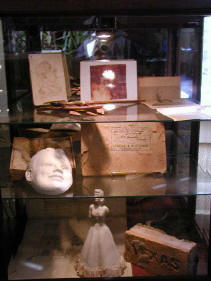
The FIFTH SHELF has a work by Frances, his youngest daughter, of her older son, Stephen Charles Gerdes at 2 years which she made in 1942. It is laying on the mold for the work. A very interesting item is in the center - it is a mailed envelope (registered) which contains a German language book that he must have ordered from a publisher in New York. The book is a study of human body proportions at various ages. This sort of publication would be of interest to a sculptor, but the family is confused about the fact that the book is written entirely in German. Note the dates and addresses: it was mailed from New York City on July 16, 1904, over a month after he and Bridgett were married, to their address in Winnipeg, 219 Garry Street, then forwarded to their address in San Francisco, 792 Ellis Street, S.F. The BOTTOM SHELF has a drawing that was never finished of an elevation view of a church and another piece done by his daughter Frances. The church appears to be similar to Our Lady of Victory Catholic Church, built in 1938, but the windows and the entry are different. It could have been an initial design, but was changed later, as he apparently abandoned the drawing before completing it. If you look closely, you can see that he drew the guide lines to enter the title block information, but abandoned the work before he lettered the title block. The young lady statue has Frances’ name scratched in the bottom, “Frances Gerdes, March 1950”. The Center CurioThe CENTER CURIO contains many representations of the Architectural works of William. The TOP SHELF
The THIRD SHELF contains additional photos of some of the projects he did, along with a “life mask” of Bridgett made about a month after they were married. It could have been made in San Francisco, as that was about the time they arrived there. The scratched note on the back of the mask reads “Mrs. Stephenson, July 24, 1904, Age 20”. The center picture is the R.W. Berry house, now the Nueces Inn. On the right are photos with captions and an isometric sketch of an unknown home.
The FIFTH SHELF holds a copy of the original proposal for the Architectural work for the Bee County Courthouse, an envelope and chip of stone from near the “Kissing Stone” at Blarney Castle along with a ticket to the Blarney Castle with a penciled date note - April 13, 1912, a receipt book, where some of his projects are logged, a photo of St. Joseph’s Catholic Church, which he designed, and some antique picture frames that were his. The Blarney Castle chip was actually collected by his father and mother, William C., Sr. and Winifred E. (Lenahan) Stephenson on a trip to Ireland. There is a family story about William and Winnie missing passage on the Titanic, and later returning to New York on the Adriatic, arriving on April 27, 1912. The SIXTH SHELF includes a book of Estimating Practices for Construction, with his signature inside, his cane that so many in Beeville remember, and an original copy of the specifications for the construction of St. Joseph’s Catholic Church. (As a child, I remember vividly watching him start his Chevy with the cane - the starter was a big button on the floorboard.)
The Right CurioThe RIGHT CURIO holds mostly pictures and mementos of William and Bridgett’s family. The TOP SHELF has a number of personal pictures: the leftmost is one of Bridgett seated and he and Frances as an infant. The small framed picture is Frances at about the same age as the bust he made. The 8x10 shows William holding Frances. He seems very happy in that photo. The center gold framed photo is Frances at approximately 17 or 18, and the small “self-photo” strip behind it is her at about 13 or 14.
Frances’ baby shoes are on the left of the shelf and on the far right is an invitation to graduation ceremonies at St. Mary’s Acadamy, dated 1928 from Grace Christine Diegel, a friend of Frances’. The SECOND SHELF has a picture of the three sisters taken at their parent’s home, a photo of Frances at about 19, and a portrait of her at 20. A poem that Frances wrote lays in front of her picture. The box camera with the back off has a patent date of 1916, and some of the “found” negatives are with it. On the right is a sketch of the front entrance of their home at 1704 North Madison. Either Frances or William made the sketch. The real prize of this display is on this shelf. It’s the unused portion of William’s round trip ticket from Buffalo to Brownsville and back.
The FORTH SHELF has mementos of his involvement with the Knights of Columbus, a half used checkbook, an invoice from Our Lady of the Lake College in San Antonio for Marion, and two photos. The picture in the silver frame is of Bridgett Anastasia Joyce’s graduating class from St. Boniface Hospital Nursing School. It was taken in 1904, just before her and William married. She is the second from the left on the front row.
The BOTTOM SHELF contains some of his song books, printed music that he read to play his violin, and a copy of William Shakespeare’s “KING HENRY THE FIFTH”, which he would quote with ease. We hope you enjoyed seeing some of W.C. Stephenson’s works, pictures, and mementos. Paul
Gerdes |
|
Updated
Tuesday, August 25, 2026 13:43 |
|
Copyright ©1999-2026 by Beeville.Net
|


%20%20Statue%20006%20(65pct).jpg)

 The
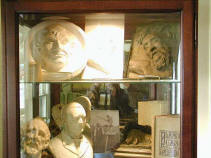
LEFT CURIO contains mostly his works of art and two works by Frances’. On the
top shelf are the likenesses of Will Rogers,
Cardinal Gibbons, the Archbishop of the Diocese of Baltimore, and Jesus Christ on the
cross, with a crown of thorns all in “plaque” form, which was his favorite form of
representing faces and heads. The Will Rogers plaque was sculpted by Frances,
and it is believed that she created it sometime before 1935, as, in an article
written about William, he mentions having the likeness to keep him company after
Bridgett died. It is not known what connection he had with the Cardinal, but
the Diocese extended to Canada and western New York. The Cardinal was very
instrumental in strengthening and expanding the reach of the Church in New York,
Maryland, and Southern Canada while he lived. There are many writings about him
and his work on the Internet. The plaque of Jesus was sculpted during World War
I after he had seen a picture of a bombed out church - and nearly everything was
totally destroyed except the plaque that miraculously survived. He decided to
produce a similar plaque to commemorate its survival.
The
LEFT CURIO contains mostly his works of art and two works by Frances’. On the
top shelf are the likenesses of Will Rogers,
Cardinal Gibbons, the Archbishop of the Diocese of Baltimore, and Jesus Christ on the
cross, with a crown of thorns all in “plaque” form, which was his favorite form of
representing faces and heads. The Will Rogers plaque was sculpted by Frances,
and it is believed that she created it sometime before 1935, as, in an article
written about William, he mentions having the likeness to keep him company after
Bridgett died. It is not known what connection he had with the Cardinal, but
the Diocese extended to Canada and western New York. The Cardinal was very
instrumental in strengthening and expanding the reach of the Church in New York,
Maryland, and Southern Canada while he lived. There are many writings about him
and his work on the Internet. The plaque of Jesus was sculpted during World War
I after he had seen a picture of a bombed out church - and nearly everything was
totally destroyed except the plaque that miraculously survived. He decided to
produce a similar plaque to commemorate its survival. 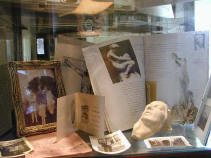 The
SECOND SHELF has one of William’s favorite works, that of Saint Francis of Assisi.
Behind the “face” you can see the molds that he used to make the copies that he gave
to friends and family. When he was 14 years old, his first major work was a five
foot statue of the Saint. That sculpture is lost now. Next to the St. Francis
likeness is that of William McKinley, the assassinated President. William assisted
his former teacher, E. Pouch, in molding the death mask of the slain President. To
the right of the McKinley bust, behind, is a photo of a World War I soldier that he
did during or immediately after the War. No one in the family knows what became of
the statue. The Dying Lion was created while he and Bridgett were in San Francisco,
sometime between January and April, 1906. The inscription “Dying Lion San Francisco,
1906” is scratched in the bottom. If you lean down and look up through the glass
shelf you can see the inscription on the bottom of the piece...The small tag with the
LION is believed to have been typed by William as a label that was used when he
entered the piece in a competition. On the far right side is a book, “Plaster Casts
and How They are Made”, with “Property of W.C. Stephenson” written in his handwriting
on the inside. If you look around the right edge of the curio, you can see the
signature. In the front of the shelf, is small piece of twisted metal that was
cut from the “armpit” of LADY JUSTICE in the process of
restoring the statue. It was given to Paul Gerdes by the restoring craftsman, John
Dennis, of the Dallas Museum of Art. The small plaque painted black at the front
of the shelf is of an unknown person. Although it appears to be in the likeness of
McKinley, the hair over the ears would negate that guess, as McKinley wore his hair
fairly short-then again, maybe he needed a haircut.
The
SECOND SHELF has one of William’s favorite works, that of Saint Francis of Assisi.
Behind the “face” you can see the molds that he used to make the copies that he gave
to friends and family. When he was 14 years old, his first major work was a five
foot statue of the Saint. That sculpture is lost now. Next to the St. Francis
likeness is that of William McKinley, the assassinated President. William assisted
his former teacher, E. Pouch, in molding the death mask of the slain President. To
the right of the McKinley bust, behind, is a photo of a World War I soldier that he
did during or immediately after the War. No one in the family knows what became of
the statue. The Dying Lion was created while he and Bridgett were in San Francisco,
sometime between January and April, 1906. The inscription “Dying Lion San Francisco,
1906” is scratched in the bottom. If you lean down and look up through the glass
shelf you can see the inscription on the bottom of the piece...The small tag with the
LION is believed to have been typed by William as a label that was used when he
entered the piece in a competition. On the far right side is a book, “Plaster Casts
and How They are Made”, with “Property of W.C. Stephenson” written in his handwriting
on the inside. If you look around the right edge of the curio, you can see the
signature. In the front of the shelf, is small piece of twisted metal that was
cut from the “armpit” of LADY JUSTICE in the process of
restoring the statue. It was given to Paul Gerdes by the restoring craftsman, John
Dennis, of the Dallas Museum of Art. The small plaque painted black at the front
of the shelf is of an unknown person. Although it appears to be in the likeness of
McKinley, the hair over the ears would negate that guess, as McKinley wore his hair
fairly short-then again, maybe he needed a haircut.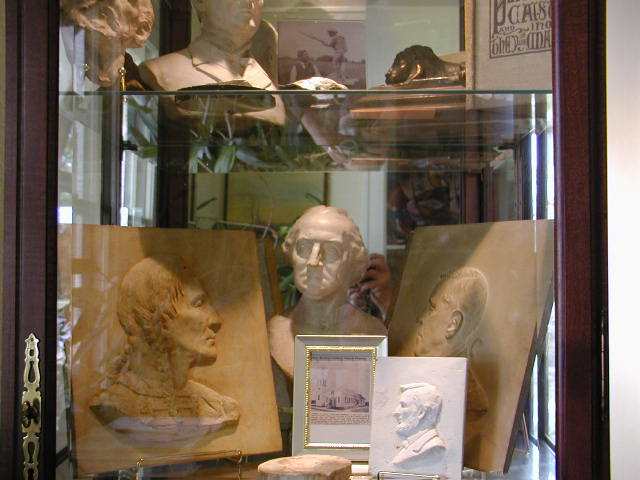
 The
FOURTH SHELF contains the form of another unknown individual, although it resembles
McKinley slightly.
The
FOURTH SHELF contains the form of another unknown individual, although it resembles
McKinley slightly.  ")
")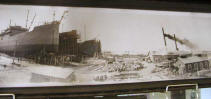 is an original panoramic photo of the Shipyards in Rockport and a
photograph of one of his Beeville offices. If you look very closely, you can see, in
the lower left corner of the shipyard photo, the notes “Heldenfels Shipyard,
Rockport, Tex., 1919”. Also, on the road to the left of the ships, you can see two
men walking together. Frances said the two men were her father William and his
partner Fritz Heldenfels. William and Fritz formed a partnership in about 1911, and
worked together until the completion of the 4 merchant marine vessels. After the
ships project was completed, the partnership was dissolved, and William returned to
Beeville to continue serving the people of Beeville on his own. They were also
the Architects of Record for the Bee County Courthouse. In the office photo on
the right, William is the one sitting at the right corner of the worktable. The
other two men are unknown individuals. William had at least two office locations:
one on the second floor of the Klipstein Building, Room 6, and the other in the Hall
Building. The picture was taken in one of those two locations.
is an original panoramic photo of the Shipyards in Rockport and a
photograph of one of his Beeville offices. If you look very closely, you can see, in
the lower left corner of the shipyard photo, the notes “Heldenfels Shipyard,
Rockport, Tex., 1919”. Also, on the road to the left of the ships, you can see two
men walking together. Frances said the two men were her father William and his
partner Fritz Heldenfels. William and Fritz formed a partnership in about 1911, and
worked together until the completion of the 4 merchant marine vessels. After the
ships project was completed, the partnership was dissolved, and William returned to
Beeville to continue serving the people of Beeville on his own. They were also
the Architects of Record for the Bee County Courthouse. In the office photo on
the right, William is the one sitting at the right corner of the worktable. The
other two men are unknown individuals. William had at least two office locations:
one on the second floor of the Klipstein Building, Room 6, and the other in the Hall
Building. The picture was taken in one of those two locations.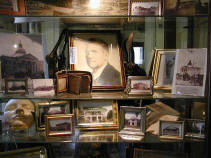 The
SECOND SHELF contains photos and two of his tools of his Architectural trade. The
photo at left is one of his most interesting facades, the Beeville Tyler Elementary
School entrance. The photo was printed from one of over 250 negatives found in
Frances’ attic recently. As you can see, the photo of the
Courthouse was taken during an ice storm, as the ice has adhered to the
columns. There was an ice storm in Beeville in January of 1926, and this fits
the time frame of many of the dates of the negatives, based on the ages of his
children. The two other photos are of the LADY JUSTICE,
which he sculpted to adorn the top of the Courthouse. The other is of the
opening of the Courthouse in 1912. The “flying saucer”
in the upper right of the picture is actually an “intersection light fixture”. On
the left, you will see a punch/brad machine used to bind sets of plans together.
The other item on the right side is his Architectural Seal, which he used to crimp
his seal image into each completed design drawing. Recently, I found his wallet,
which has in it his last driver’s license and his registration card of his Texas
Architectural License.
The
SECOND SHELF contains photos and two of his tools of his Architectural trade. The
photo at left is one of his most interesting facades, the Beeville Tyler Elementary
School entrance. The photo was printed from one of over 250 negatives found in
Frances’ attic recently. As you can see, the photo of the
Courthouse was taken during an ice storm, as the ice has adhered to the
columns. There was an ice storm in Beeville in January of 1926, and this fits
the time frame of many of the dates of the negatives, based on the ages of his
children. The two other photos are of the LADY JUSTICE,
which he sculpted to adorn the top of the Courthouse. The other is of the
opening of the Courthouse in 1912. The “flying saucer”
in the upper right of the picture is actually an “intersection light fixture”. On
the left, you will see a punch/brad machine used to bind sets of plans together.
The other item on the right side is his Architectural Seal, which he used to crimp
his seal image into each completed design drawing. Recently, I found his wallet,
which has in it his last driver’s license and his registration card of his Texas
Architectural License.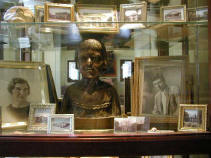 The
FOURTH SHELF'S centerpiece is a bust of Frances Delores Stephenson, at about age 6.
The photos to the left and right are of Bridgett Anastasia Joyce Stephenson and
William Charles Stephenson, Jr. The cutout in front of Bridgett’s picture is a place
card in the image of St. Joseph’s Church, probably for a ladies function there. The
small card and copper plate used to print Frances’ “Card”, interestingly is
misspelled (with a "v" in "Stephenson"). The pen in front of William’s picture is
the pin he wore at the Knights of Columbus convention in San Angelo - “the end of the
rainbow”, date unknown. Next to the pin is one of his calling cards he used while
his office was in the Hall Building.
The
FOURTH SHELF'S centerpiece is a bust of Frances Delores Stephenson, at about age 6.
The photos to the left and right are of Bridgett Anastasia Joyce Stephenson and
William Charles Stephenson, Jr. The cutout in front of Bridgett’s picture is a place
card in the image of St. Joseph’s Church, probably for a ladies function there. The
small card and copper plate used to print Frances’ “Card”, interestingly is
misspelled (with a "v" in "Stephenson"). The pen in front of William’s picture is
the pin he wore at the Knights of Columbus convention in San Angelo - “the end of the
rainbow”, date unknown. Next to the pin is one of his calling cards he used while
his office was in the Hall Building.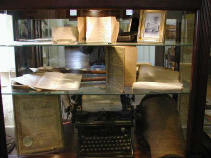 The
BOTTOM SHELF contains the framed original of his TEXAS ARCHITECTURAL LICENSE, copies
of the Registered Architects of Texas (his license number was 741-you can see his
listing on the open page), and his typewriter. The page in the typewriter is the
first page of the specifications for St. Joseph’s Catholic Church. To the right of
the typewriter is a glazed roof tile from the family home at 1709 Madison found on
the 10th of September, 2001 in the brush. The tile was a favorite roof material that
he used in his designs. They will last forever.
The
BOTTOM SHELF contains the framed original of his TEXAS ARCHITECTURAL LICENSE, copies
of the Registered Architects of Texas (his license number was 741-you can see his
listing on the open page), and his typewriter. The page in the typewriter is the
first page of the specifications for St. Joseph’s Catholic Church. To the right of
the typewriter is a glazed roof tile from the family home at 1709 Madison found on
the 10th of September, 2001 in the brush. The tile was a favorite roof material that
he used in his designs. They will last forever.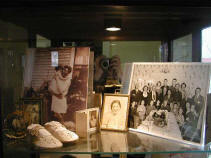 The
large photo on the right was taken at Christmas, 1953. It is of William with his
children and many of his grandchildren. From left to right, back row, they are
Joseph McBride, husband of Marion Stephenson standing next to him, Joan Frances
McBride, Joyce Ann McBride, James Francis Goodwin, Dennis Patrick McBride, and
Bridget Ann Goodwin. On the next to the back row is William Charles, Winifred Cecelia
(Stephenson) Goodwin, Frances Delores (Stephenson) Gerdes, her husband Hilary Paul
Gerdes, and his mother, Antonio Francis Meyer, and John Harold Kelly. Seated on the
front row are Marion Patricia McBride, Kathleen Rachel Goodwin, William Charles
Goodwin, Kathryn McBride, Margaret Janice McBride, Stephen Charles Gerdes, Francis
Paul Gerdes, and Mary Joyce Kelly holding James Patrick Kelly. The table is set for
a wonderful Christmas Dinner.
The
large photo on the right was taken at Christmas, 1953. It is of William with his
children and many of his grandchildren. From left to right, back row, they are
Joseph McBride, husband of Marion Stephenson standing next to him, Joan Frances
McBride, Joyce Ann McBride, James Francis Goodwin, Dennis Patrick McBride, and
Bridget Ann Goodwin. On the next to the back row is William Charles, Winifred Cecelia
(Stephenson) Goodwin, Frances Delores (Stephenson) Gerdes, her husband Hilary Paul
Gerdes, and his mother, Antonio Francis Meyer, and John Harold Kelly. Seated on the
front row are Marion Patricia McBride, Kathleen Rachel Goodwin, William Charles
Goodwin, Kathryn McBride, Margaret Janice McBride, Stephen Charles Gerdes, Francis
Paul Gerdes, and Mary Joyce Kelly holding James Patrick Kelly. The table is set for
a wonderful Christmas Dinner.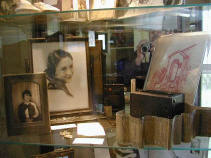 The
THIRD SHELF, in the back, has an ink drawing done by Frances of Christ on the Cross,
a most remarkable work. The gold framed picture is of William and his three lovely
daughters, Winifred, Marion, and Frances. The open invitation at the front of the
shelf is an invitation to a graduation for the 1928 Class of Beeville High School
held at the Rialto Theater. The card in front is Miss Bessie Mae Bauer, Frances very
best friend, who later married Judge John May, of Karnes City. They are now retired
and live in Austin. The book in back was published by Robin Borglum Carter about the
life and works of her grandfather, Gutzon Borglum. The book is open to a page that
talks about the small likeness of a woman’s head. Gutzon gave William one of the
works, as the book cites that “he made many copies and gave them to friends”. The
two photos in the same frame are William with his horse and carriage (with the Lyne’s
house in the background) and one with his 1940 Chevy Coupe, with his grandson,
Stephen Charles Gerdes on the running-board. The picture laying flat is William on
the front porch of his home on Madison.
The
THIRD SHELF, in the back, has an ink drawing done by Frances of Christ on the Cross,
a most remarkable work. The gold framed picture is of William and his three lovely
daughters, Winifred, Marion, and Frances. The open invitation at the front of the
shelf is an invitation to a graduation for the 1928 Class of Beeville High School
held at the Rialto Theater. The card in front is Miss Bessie Mae Bauer, Frances very
best friend, who later married Judge John May, of Karnes City. They are now retired
and live in Austin. The book in back was published by Robin Borglum Carter about the
life and works of her grandfather, Gutzon Borglum. The book is open to a page that
talks about the small likeness of a woman’s head. Gutzon gave William one of the
works, as the book cites that “he made many copies and gave them to friends”. The
two photos in the same frame are William with his horse and carriage (with the Lyne’s
house in the background) and one with his 1940 Chevy Coupe, with his grandson,
Stephen Charles Gerdes on the running-board. The picture laying flat is William on
the front porch of his home on Madison.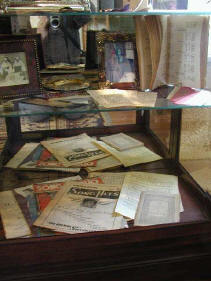 The
FIFTH SHELF has one of the last pictures taken of William, bedridden with his priest
and two nuns, his obituary, mementos of the 1936 Exposition in Dallas, three
postcards he wrote to Frances, and a paddle. The paddle could have been from
Frances’ days of teaching school, when paddles really worked.
The
FIFTH SHELF has one of the last pictures taken of William, bedridden with his priest
and two nuns, his obituary, mementos of the 1936 Exposition in Dallas, three
postcards he wrote to Frances, and a paddle. The paddle could have been from
Frances’ days of teaching school, when paddles really worked.